
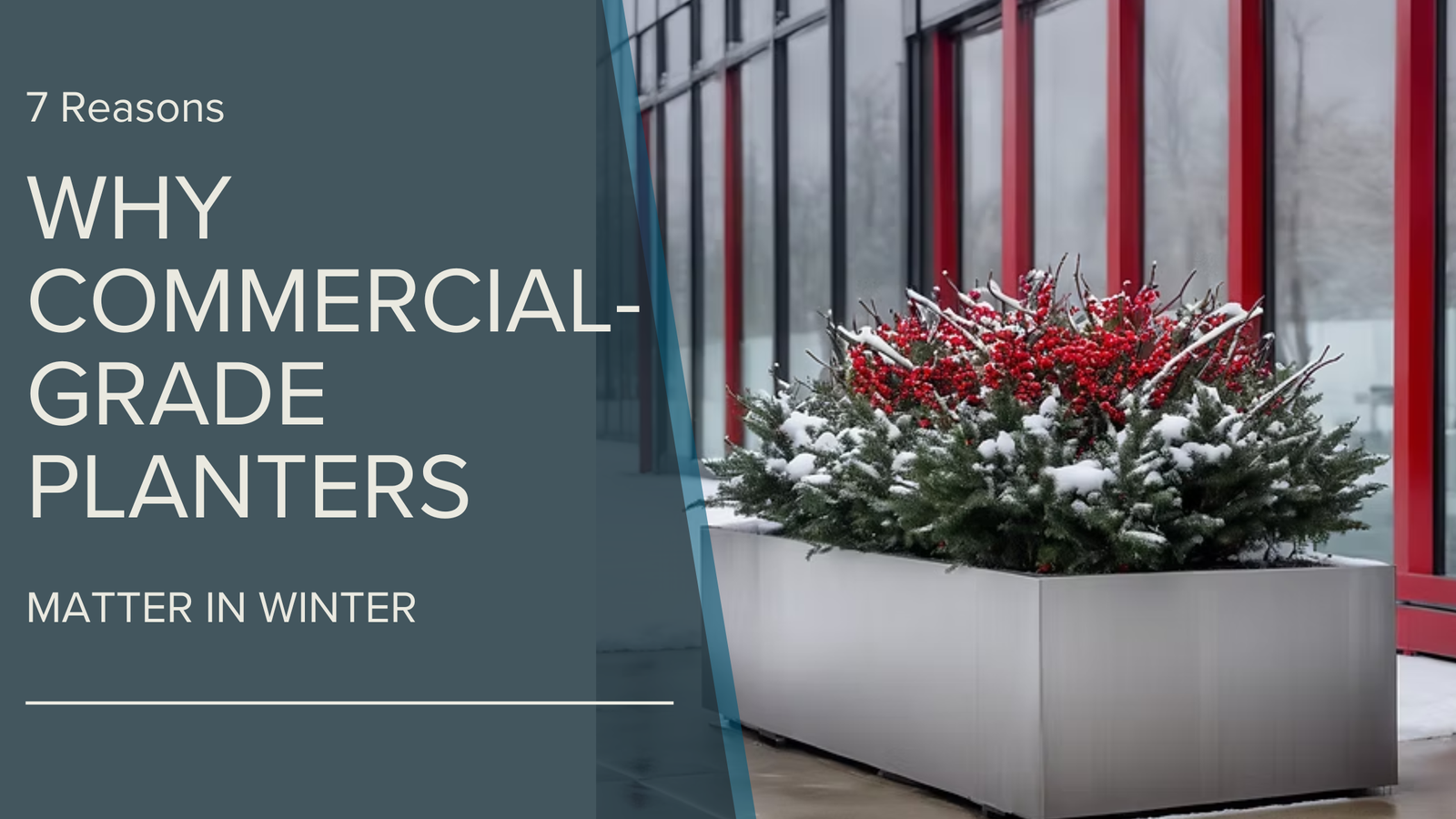
When December arrives, the real performance gap between commercial-grade planters and big-box consumer products becomes impossible to ignore. Freeze–thaw cycles, winter winds, de-icing salts, and heavy seasonal décor expose weaknesses in inferior containers. This can lead to plant loss, cracked materials, extra service calls, and frustrated clients.
For landscape professionals responsible for entrances, retail plazas, corporate campuses, and hospitality environments, choosing the right planter material isn’t just about aesthetics. It’s about performance, safety, and long-term value.
Below is an educational breakdown for the material we carry at Mount Vernon Vessels & Vines: fiberglass, metal, and composite wood cladding and why they outperform consumer-grade planter options every single winter.
- Material Strength: Engineered for Four Seasons
Fiberglass Planters (Commercial-Grade)
- Built from reinforced layers of fiberglass and resin. The more layers the stronger the planters will be. You will also notice ribs and support structure build into the design and interior of the planters.
- Won’t crack in freeze–thaw cycles.
- UV-stable finishes prevent fading, chalking, or brittleness.
- Lightweight enough for rooftops and balconies but durable enough for high-traffic settings.
Lower-Grade Plastic/Resin:
Fewer layers of fiberglass and resin, low-density plastics contract and expand rapidly in cold weather.
Metal Planters (Powder-Coated Stainless or Aluminum)
- Highly stable through extreme winter temperatures.
- A thick gauge product allows the media and roots to keep the planters’ shape without bulging the planter over time.
- Robust structure supports heavy birch poles, greens, or holiday lighting hardware.
- Powder coating resists corrosion from salt and moisture.
- Cheap Steel or Untreated Metals:
Lower-quality metals rust, stain hardscapes, and fail structurally under winter moisture. Make sure product is not painted as it will not hold it’s finish for a long time like powder-coating will.
Composite Wood-Clad Planters
- Provide the warmth of wood with no rotting, splitting, or warping.
- Dimensionally stable even when exposed to snow, ice, or repeated freeze–thaw cycles.
- Exterior-grade fastening and engineering ensure cladding stays tight through winter expansion.
- Lower-Grade Wood or Thin Composites:
Consumer products typically swell, delaminate, or discolor over time.
- Root Protection & Soil Insulation
A planter’s wall thickness and thermal performance directly impact plant survival.
Commercial Fiberglass
- Even wall thickness insulates roots better than thin vacuum-molded plastics.
- Prevents flash freezing of the root zone during extreme overnight temperature drops.
Commercial Metal
- Metal conducts temperature quickly, but commercial-grade fabrication allows for:
- Additional insulation layers
- Thermal breaks
These prevent rootballs from being exposed to severe temperature swings.
Composite Wood-Clad Planters
- Cladding adds natural insulation around the inner liner.
- Excellent for evergreen arrangements and long-term installations in northern climates.
Consumer-Grade Difference:
Thin plastic or ceramic containers offer almost no thermal protection, leading to rapid root damage long before foliage shows symptoms.
- Structural Integrity & Stability
Fiberglass
- Lightweight yet strong—ideal for rooftops or windy plazas.
- Resistant to bowing or buckling when filled with saturated winter soil because of material thickness.
Metal
- Extremely stable in high-wind environments because of their weight.
- Ideal for large-format commercial entrances or exposed landscapes.
Wood-Clad Composites
- Added structural frame ensures containers stay grounded and secure.
- Perfect for hospitality or retail environments where planters double as subtle space dividers.
- Performance Under Salt, Moisture, and Heavy Décor Loads
Winter containers often bear more weight than summer ones—birch poles, dogwood, oversized ornaments, lighting, and greens.
Fiberglass Advantage
- Will not absorb moisture or soften.
- Maintains shape under load and resists scratches from winter décor components. If you ever need touch-up kits, we have you covered!
Metal Advantage
- Structural strength supports heavy installations.
- Powder coating protects from corrosion, salt spray, and snow accumulation.
Composite Wood-Clad Advantage
- No warping or softening from moisture exposure.
- Excellent for upscale holiday designs where a natural look is desired.
Consumer-Grade Issue:
Lower-grade ceramics crack. Plastics deform. Wood rots or splits.
- Longevity & True Cost of Ownership
Professionals know that the cheapest product is rarely the cheapest long term.
Commercial-Grade Fiberglass
- 15+ year lifespan with minimal maintenance.
- Maintains color, shape, and integrity season after season.
Commercial-Grade Metal
- Decades of performance with protective coatings.
- Ideal for permanent installations or high-visibility commercial environments.
Composite Wood-Clad
- Multi-year durability with no painting, sealing, or rot repair.
- Maintains premium appearance even after harsh winters.
Lower-Grade Alternative:
Most consumer-grade planters last a couple of years at best—especially in winter.
- Brand Aesthetics & Professional Design Standards
Your commercial-grade product lines are designed for architectural consistency and scalable site planning, which matters for:
- Retail centers
- Hotels & resorts
- Mixed-use developments
- Corporate campuses
- Municipal streetscapes
- Healthcare facilities
Commercial Fiberglass
- Clean, modern finishes
- Large format sizing
- Custom colors for brand alignment
Commercial Metal
- Contemporary, structured aesthetics
- Sleek, minimal design language
Composite Wood-Clad
- Warm, natural appearance without the maintenance of real wood
- Ideal for hospitality or luxury residential settings
Consumer-Grade Problem:
Mismatched finishes, inconsistent colors, and limited sizes break visual continuity—a real issue for commercial properties.
- Safety, Liability & Public-Space Durability
Commercial installations require products that won’t tip, crack, or degrade under public use.
Our products meet that standard.
- Fiberglass won’t shatter.
- Metal maintains structural integrity in pedestrian environments.
- Composite wood stays stable even when bumped or leaned on.
Lower-end products introduce risk—especially in icy conditions or high-traffic areas.
Conclusion: Commercial-Grade Planters Deliver Proven Winter Performance
Investing in commercial-grade fiberglass, metal, and wood-composite planters isn’t just a design choice, it’s a performance decision. In December, the stakes are higher:
- Plants need insulation.
- Containers need strength.
- Materials must endure salt, wind, ice, and heavy seasonal décor.
Commercial products deliver on all fronts: durability, safety, aesthetics, root protection, and long-term value.
For professionals, property managers, and designers, choosing commercial-grade containers is the surest way to protect winter plantings, and the brand image of every site they manage.
Elevate your next project with planters built for long-term performance. Explore our commercial-grade fiberglass, metal, and wood-look collections today. Need assistance, email us and we will be happy to discuss the right material for your project.
Frequently Asked Questions: Why Choose Commercial-Grade Planters?

What makes commercial-grade planters different from lower-grade options?
Commercial planters are engineered for long-term outdoor use, using thicker materials, reinforced construction, and UV-stable finishes. They’re built to handle heavy soil loads, winter weather, and high-traffic environments. Lower-grade retail planters often crack, fade, or deform after a couple of years.
How do commercial fiberglass, metal, and wood-look materials perform in winter?
Commercial fiberglass resists cracking and fading, commercial-grade metal features architectural powder coating that prevents rust, and composite wood-look cladding won’t rot, swell, or deteriorate in moisture. All three materials are designed to stay structurally sound through freeze-thaw cycles and December installations.
Are commercial-grade planters worth the investment?
Yes—commercial planters typically last 10–20+ years, require minimal maintenance, and maintain a high-end appearance. The longer lifecycle and reduced replacement frequency provide significant ROI for property managers, designers, and contractors, especially across multiple sites or year-round displays.