
A Technical Guide to Plant Water Stress, Root-Zone Moisture Assessment, Hand Watering, and Irrigation Best Practices
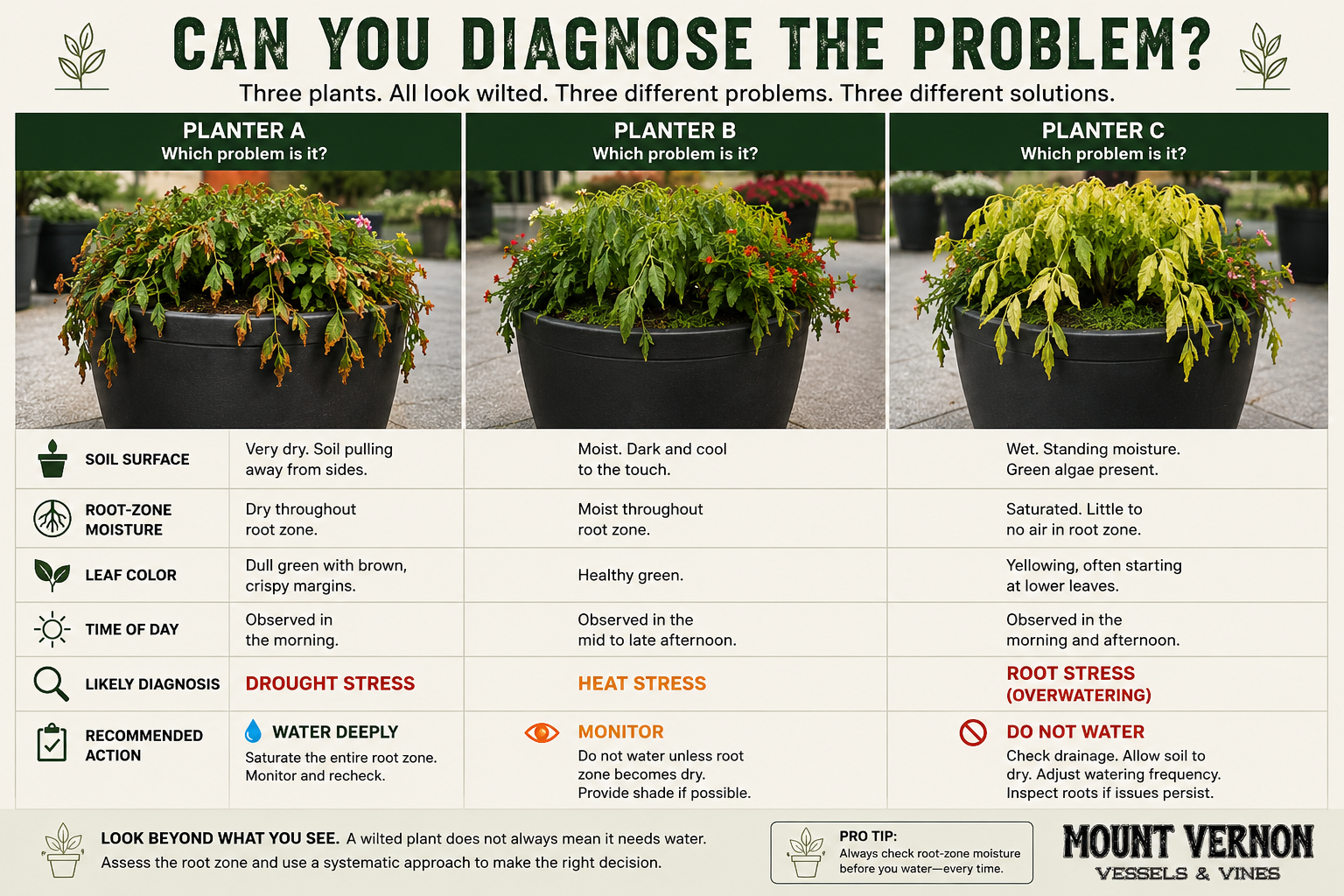
Summer presents the greatest irrigation challenge of the year for commercial container gardens. Unlike plants growing in the ground, containerized plants have a limited volume of growing media, elevated root-zone temperatures, and are exposed to increased evaporation from heat, wind, and solar radiation. These conditions can cause water demand to change dramatically from one day to the next, making proper watering one of the most important responsibilities of landscape maintenance professionals.
Successful watering is more than simply applying water on a schedule. It requires understanding plant physiology, recognizing the early signs of stress, and accurately determining whether a plant truly needs water before reaching for a hose or adjusting an irrigation controller.
One of the most common mistakes in landscape maintenance is assuming that every wilted plant needs more water. In reality, similar symptoms can result from three very different conditions, each requiring a different management approach.
Recognizing the Three Types of Plant Water Stress
- Drought Stress (Insufficient Soil Moisture)
Symptoms
- Persistent morning wilting
- Curling leaves
- Brown leaf margins
- Premature flower drop
- Dry growing media
- Reduced growth
- Dry root ball pulling away from container walls
Common Causes
- High temperatures
- Wind
- Insufficient irrigation
- Hydrophobic growing media
- Small soil volume
- Large mature plants
Corrective Action Verify that the entire root zone is dry before applying a slow, deep watering that completely saturates the growing media.
2. Heat Stress (Hight Transpiration Demand)
Symptoms
- Afternoon wilting
- Leaf rolling
- Temporary flower drop
- Recovery overnight
- Moist growing media
Common Causes
- High temperatures
- Low humidity
- High solar radiation
- Wind
- Heat reflected from pavement or buildings
Corrective Action Always perform a root-zone moisture assessment before watering. Additional irrigation may not be necessary if adequate moisture remains in the growing media.
3. Root Stress from Overwatering (Oxygen Deficiency)
Symptoms
- Wilting despite wet soil
- Yellow foliage
- Soft new growth
- Root rot
- Fungus gnats
- Moss or algae
- Sour-smelling growing media
Common Causes
- Excessive irrigation
- Poor drainage
- Clogged drainage holes
- Heavy growing media
- Incorrect irrigation scheduling
Corrective Action Allow the growing media to dry to an appropriate moisture level, improve drainage, and evaluate irrigation scheduling before applying additional water.
The Professional Pre-Watering Assessment Protocol
Seven Questions Every Landscape Technician Should Ask Before Watering
Professional landscape maintenance is about making informed decisions—not simply following a schedule.
Before watering, every technician should ask:
1. Is the Root Zone Actually Dry?
Conduct a complete root-zone moisture assessment using a finger test, soil probe, container weight, or moisture meter.
2. Is the Plant Experiencing Drought Stress, Heat Stress, or Root Stress?
Identify the type of stress before determining the appropriate corrective action.
3. Are Environmental Conditions Increasing Water Demand?
Evaluate temperature, humidity, wind, solar radiation, reflected heat, and recent weather conditions.
4. Is the Growing Media Accepting Water Properly?
Inspect for hydrophobic media, runoff, dry pockets, and poor infiltration.
5. Is the Irrigation System Operating Correctly?
Inspect emitters, tubing, pressure, controllers, and distribution uniformity.
6. Are the Plants Compatible?
Determine whether plant species share similar water requirements and whether root competition has increased water demand.
7. What is the Best Watering Method?
Determine whether hand watering, drip irrigation, micro-irrigation, or irrigation adjustments are the most appropriate solution.
Watering Protocols For Professionals
Apply Water Correctly
Once the decision to water has been made, the goal is to completely hydrate the root zone rather than simply wet the soil surface.
Professional hand watering should:
- Apply water slowly enough for proper infiltration.
- Saturate the entire root profile.
- Eliminate dry pockets.
- Minimize runoff.
- Avoid excessive foliage wetting whenever practical.
If the growing media has become hydrophobic, multiple slow watering cycles may be required before water penetrates the entire root ball.
Know When to Stop Watering
Professional watering is measured by effectiveness—not by time.
A properly watered container should reach container capacity, meaning the growing media has been thoroughly hydrated while still maintaining adequate air space for healthy root function.
Indicators of successful watering include:
- Uniform moisture throughout the container.
- Elimination of dry pockets.
- A small amount of drainage from the bottom of the planter.
- Minimal runoff around the container. If you flush out the container each time you water, you will be losing critical nutrients and probable staining of the surface around the container.
Deep, thorough watering encourages stronger root development and helps flush accumulated soluble salts from the growing media.
Verify the Results
Before moving to the next planter, confirm that watering accomplished its objective.
Ask:
- Did water reach the entire root zone?
- Is drainage functioning properly?
- Was runoff minimized?
- Does the growing media appear uniformly moist?
- Will the container likely remain healthy through the next heat cycle?
Verification is the final step that separates professional watering from routine watering.
Common Hand Watering Mistakes in Commercial Container Gardens
Understanding these common mistakes—and how to avoid them—helps improve irrigation efficiency, reduce plant stress, and promote healthier, more resilient commercial container gardens.
Mistake #1: Watering on a Schedule Instead of Plant Need
Water requirements change daily based on weather, plant maturity, container size, and growing media. A schedule that works one week may result in overwatering or underwatering the next.
Professional Best Practice
Always begin with a root-zone moisture assessment before deciding to irrigate.
Mistake #2: Judging Moisture by the Soil Surface
The top inch of growing media often dries much faster than the root zone below. Watering simply because the surface appears dry can result in chronic overwatering.
Conversely, recent rainfall may leave the surface damp while deeper portions of the container remain dry.
Professional Best Practice
Assess moisture throughout the root profile using a finger test, soil probe, container weight, or soil moisture meter.
Mistake #3: Watering Too Quickly
Applying water faster than the growing media can absorb it causes runoff along the container walls or across the soil surface.
This wastes water and often leaves much of the root ball dry.
Professional Best Practice
Apply water slowly enough to allow complete infiltration. Large containers or dry growing media may require multiple watering passes.
Mistake #4: Failing to Fully Saturate the Root Zone
Light watering that only wets the upper few inches of growing media encourages shallow root development.
Plants become increasingly dependent on frequent irrigation and are less resilient during periods of heat and drought.
Professional Best Practice
Water deeply until the entire root zone reaches container capacity and a small amount of drainage is observed.
Mistake #5: Ignoring Hydrophobic Growing Media
Growing media that has dried excessively may repel water, causing irrigation to bypass the root ball entirely.
This often leads technicians to believe the container has been watered when the root zone remains dry.
Professional Best Practice
Watch for runoff immediately after watering. If the media has become hydrophobic, apply several slow watering cycles to gradually rehydrate the entire root profile.
Mistake #6: Watering Only One Side of the Container
Directing water to a single location creates uneven moisture distribution and may leave portions of the root system dry.
This problem is especially common in large rectangular planters and oversized commercial containers.
Professional Best Practice
Move the watering wand around the container to distribute water evenly across the entire planting area.
Mistake #7: Wetting Foliage Instead of the Root Zone
Although occasional foliage wetting is unavoidable, directing most of the water onto leaves instead of the growing media reduces irrigation efficiency.
Extended leaf wetness may also increase the risk of certain foliar diseases.
Professional Best Practice
Aim water directly at the growing media surrounding the root zone whenever practical.
Mistake #8: Ignoring Drainage Problems
Applying additional water will not correct problems caused by clogged drainage holes, compacted growing media, or standing water.
Poor drainage often produces symptoms that resemble drought stress.
Professional Best Practice
Inspect drainage regularly and correct the underlying issue before increasing irrigation frequency.
Mistake #9: Treating Every Container the Same
Commercial landscapes often contain a wide variety of planter sizes, plant species, sun exposures, and growing media.
Applying the same watering routine to every container rarely produces consistent results.
Professional Best Practice
Adjust watering practices based on container volume, plant selection, environmental exposure, and seasonal growth.
Mistake #10: Leaving Without Verifying Results
The final mistake occurs after watering is complete.
Many technicians immediately move to the next planter without confirming that water actually penetrated the root zone.
Successful irrigation is not measured by the amount of time spent watering—it is measured by the effectiveness of the watering event.
Professional Best Practice
Before leaving the planter, verify that:
- The root zone has been thoroughly hydrated.
- Water has infiltrated evenly throughout the container.
- Drainage is functioning properly.
- Runoff has been minimized.
- The container is prepared to withstand the next period of environmental stress.
Conclusion
Whether watering by hand or managing a sophisticated irrigation system, the goal remains the same: deliver the right amount of water, at the right time, using the right method.
By combining horticultural knowledge with modern irrigation technologies and consistent field observation, landscape professionals can improve plant health, reduce water waste, extend the life of commercial container plantings, and provide greater value to their clients.
Proper summer planning for your container installations isn’t just about aesthetics—it’s about protecting your investment and ensuring resilience.
📩 Need help designing, maintaining, or retrofitting summer-ready planters? Our team specializes in customized container garden solutions tailored to commercial settings. Email us today for expert guidance or support.

Frequently Asked Questions (FAQ)
A: There is no universal watering schedule for commercial containers. Water requirements vary based on plant species, container size, growing media, weather conditions, sun exposure, and root development. Rather than watering on a calendar, landscape professionals should perform a root-zone moisture assessment before each irrigation event to determine whether watering is actually needed.
A: Early morning is generally the most effective time to water commercial planters. Cooler temperatures and lower wind speeds reduce evaporation while allowing plants to absorb moisture before the hottest part of the day. Morning watering also allows foliage to dry quickly, reducing the potential for disease development.
A: Never rely solely on wilted foliage or a dry-looking soil surface. The most reliable approach is to assess moisture throughout the root zone using a soil probe, finger test, container weight, or soil moisture sensor. Plants may wilt from drought stress, heat stress, or root stress caused by overwatering, making proper diagnosis essential.
A: Wilting does not always indicate drought stress. During periods of extreme heat, plants can temporarily lose water through transpiration faster than roots can absorb it, resulting in heat stress. Likewise, saturated growing media can limit oxygen availability to the roots, producing symptoms that resemble drought stress. Always evaluate root-zone moisture before applying additional water.
A: The goal is to fully hydrate the entire root zone—not simply wet the soil surface. Water should be applied slowly enough to allow complete infiltration. Thorough watering helps eliminate dry pockets and encourages deeper, healthier root systems. Extension guidance also notes that hydrophobic media may require multiple slow applications to fully rewet.
A: Growing media that has dried excessively can become hydrophobic, causing irrigation water to flow around the root ball instead of penetrating it. Symptoms include rapid runoff, dry pockets within the container, and soil pulling away from the container walls. Slow, repeated watering cycles are often necessary to fully rehydrate the growing media.
A: Not necessarily. Some containers may require daily watering during periods of extreme heat, while others may retain adequate moisture for several days depending on container size, plant selection, growing media, and environmental conditions. Watering should always be based on root-zone moisture rather than a fixed schedule.
A: For most commercial container installations, drip irrigation and micro-irrigation systems provide the greatest efficiency because they deliver water directly to the root zone while minimizing evaporation and runoff. Pairing these systems with smart controllers and soil moisture sensors can further improve irrigation efficiency and reduce water waste.
A: Yes. Overwatering is one of the most common causes of plant decline in container gardens. Saturated growing media reduces oxygen availability around the roots, increasing the risk of root rot, nutrient deficiencies, poor growth, and eventual plant failure. In many cases, overwatered plants exhibit symptoms that closely resemble drought stress, making proper diagnosis essential before irrigation decisions are made.